
Since 2014
Ten Years of Reliability Your Trusted Partner
Ten Years of Reliability Your Trusted Partner
|
1. Category Definition of Low Bed Trailer |
4. Premium Engineering vs. Cost-Cutting Practices |
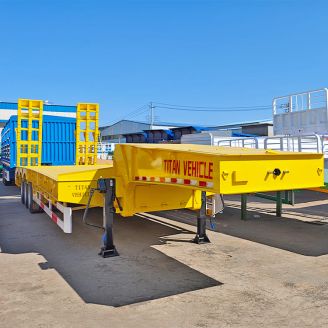
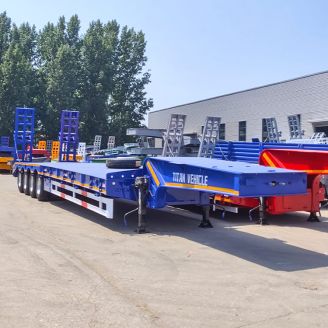
A lowbed trailer—also designated as a lowboy, drop-deck, or step-frame semi-trailer—is a specialized heavy haulage transport platform engineered with a depressed deck height (typically 800 mm to 1,100 mm above ground) to haul heavy machinery, crawler equipment, and oversized industrial loads exceeding standard height and weight regulations. Utilizing high-yield structural steel frames such as Q460C (HG60), a lowbed trailer for sale accommodates nominal payload capacities from 40 to over 100 metric tons while maintaining a competitive low bed trailer price for fleet operators. Leading low bed trailer manufacturers design these units with a lowered center of gravity that maximizes lateral stability and vertical clearance under bridges, power lines, and transport infrastructure during off-road and highway haulage across industrial routes in Nigeria.
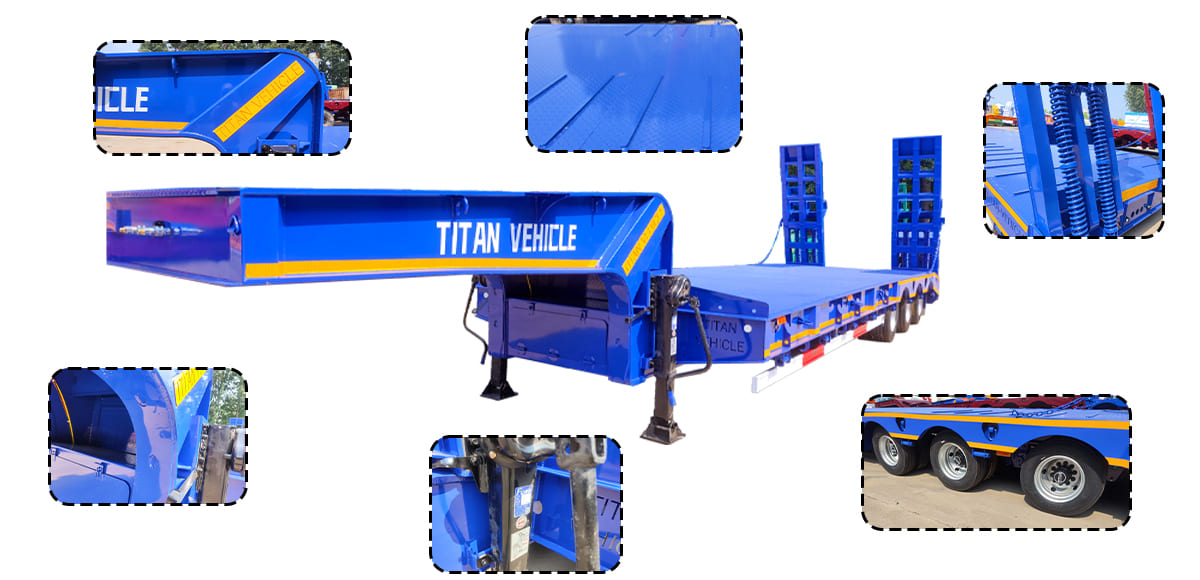 Low Bed Trailer Price | Heavy Duty Lowbed Trailer Manufacturers for Sale in Nigeria
A lowbed trailer's structural integrity depends on precise engineering parameters set by top low bed trailer manufacturers. Below is a standard technical specifications matrix comparing primary structural configurations engineered for heavy-duty earthmoving, forestry, and industrial logistics applications in Nigeria, helping fleet managers evaluate structural options against the overall low bed trailer price when purchasing a lowbed trailer for sale.
| Specification Parameter | 60 Ton 3 Axle Configuration | 80 Ton 4 Axle Configuration | 150 Ton 4 Line 8 Axle Configuration |
| Payload Capacity | 60,000 kg (60 Tons) | 80,000 kg (80 Tons) | 150,000 kg (150 Tons) |
| Main Beam Material | Q460C(HG60) High-Tensile Steel (Minimum 460 MPa Yield Strength) | ||
| Main Beam Structure | Upper Flange: 20mm, Lower: 20mm, Web: 12mm (200 mm Wide) | Upper Flange: 20mm, Lower: 20mm, Web: 14mm (200 mm Wide) | Upper Flange: 20mm, Lower: 20mm, Web: 12mm (230 mm Wide) |
| Side Beam Structure | 3000mm high Rolled H-Beam (Top: 8mm, Mid: 6mm, Bottom: 10mm) |
300mm Rolled H-Beam (Top: 8mm, Mid: 8mm, Bottom: 10mm) |
380mm Rolled H-Beam (Top: 10mm, Mid: 8mm, Bottom: 10mm |
| Gooseneck Design | Rigid Reinforced Double Plate Architecture | ||
| Axle Configuration | TITAN 13 Ton Axles (FUWA / BPW) | TITAN 13 Ton Axles (FUWA / BPW) | TITAN150 Ton 4 Line 8 Axles |
| Floor Deck Plate | 5 mm Heavy-Duty Steel Diamond Checker Plate | ||
| Loading Ramps | Double Spring Ramp | Double Spring Ramp | Heavy Duty Spring Ramp |
| Landing Gear | JOST / FUWA 28 Ton Landing Gear | ||
| Braking System | Dual-Line Pneumatic Braking System with WABCO Relay Valve | ||
| Surface Coating | Electrostatic Powder Spray Baking | ||
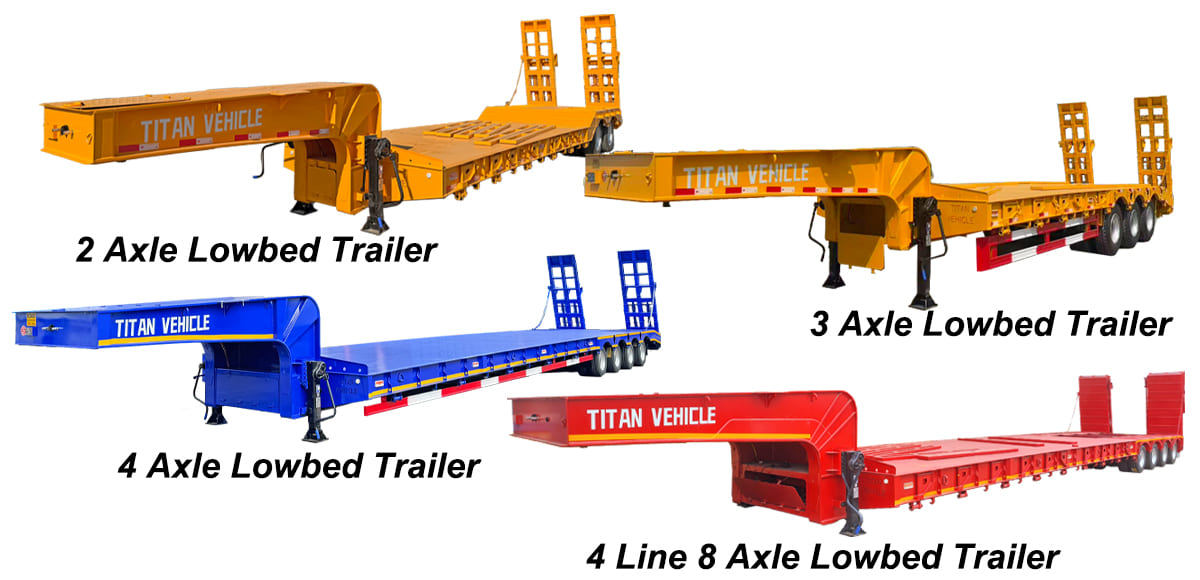 Low Bed Trailer Price | Heavy Duty Lowbed Trailer Manufacturers for Sale in Nigeria
Main beam structural mechanics require precise material selection to withstand extreme vertical bending moments and cyclic dynamic loads when moving heavy machinery over unpaved terrain in Nigeria. The main longitudinal beams of a high-capacity lowbed trailer must maintain structural elasticity without plastic deformation, making Q460C (HG60) high-strength steel the industry standard for loads exceeding 60 metric tons. When purchasing a lowbed trailer for sale, steel quality directly affects both dynamic durability and the overall low bed trailer price.
The load distribution across a low bed trailer manufacturers frame dictates that bending stress increases proportionally with the concentrated machinery load and the length of the span between axles. When heavy excavators or track loaders land on a localized section of the cargo platform, the upper flange of the main beam undergoes intense compression while the lower flange experiences severe tensile stress.
● Q235 Carbon Steel: Offers a low yield strength of roughly 235 MPa. It is used primarily in light utility applications. When subjected to concentrated equipment payloads exceeding 50 tons, Q235 steel reaches its elastic limit quickly, causing irreversible downward sagging of the main deck.
● T700 High-Strength Steel: Features a high nominal yield strength near 700 MPa. Although T700 exhibits impressive static tensile performance, it suffers from reduced material elongation and lower impact toughness under sudden physical shocks. When an excavator track drops over unpaved ruts or boulders, the rapid impact force can initiate brittle micro-cracking along the heat-affected zones of welded T700 web plates.
● Q460C (HG60) High-Strength Steel: Delivers a yield strength of at least 460 MPa and tensile strength up to 700 MPa, combined with guaranteed Charpy V-notch impact energy absorption down to -20°C. Since 2021, leading low bed trailer manufacturers have phased out Q345B steel on trailers rated above 60 tons in favor of Q460C. It provides the optimal balance of yield strength, flexural fatigue resistance, and fracture toughness, absorbing extreme dynamic shocks without structural cracking.
Automated Submerged Arc Welding (SAW) machines assemble all longitudinal I-beams. Continuous double-sided deep penetration welds eliminate internal air pockets, micro-slag inclusions, and localized stress concentrators at the web-to-flange junction.
Gooseneck structural engineering demands reinforced lower flange plates and double-web geometry to safely transfer massive payload forces from the depressed cargo deck to the tractor unit's fifth wheel. The transition point where the gooseneck curves upward represents the highest concentration of bending moment and shear stress across the entire lowbed trailer frame.
When transporting heavy crawler tractors over undulating haul roads in Nigeria, the gooseneck experiences combined vertical bending and torsional twisting. Unreinforced single-plate goosenecks frequently develop stress cracks near the lower bend radius. Professional low bed trailer manufacturers address this issue by integrating a double-plate design into every lowbed trailer for sale.
● Dual parallel vertical web plates double the structural section modulus across the critical bend radius.
● A thick, continuous lower gusset reinforcement plate extends through the entire curved section, lowering localized stress levels below the material fatigue threshold.
● Reinforced transition gussets gradually transfer structural loads into the main deck I-beams, preventing sudden stiffness changes that cause metal fatigue.
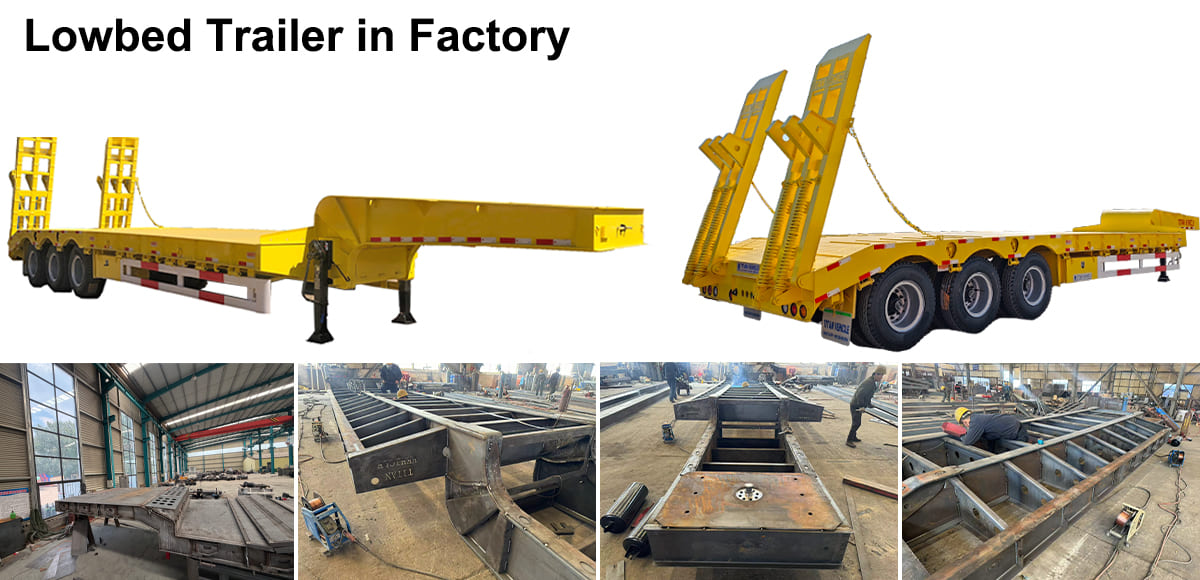 Low Bed Trailer Price | Heavy Duty Lowbed Trailer Manufacturers for Sale in Nigeria
Side beam construction and crossmember spacing determine a lowbed trailer's torsional stiffness, preventing deck twist when heavy equipment loads off-center on unpaved construction sites in Nigeria. Incorporating 6mm thick HG60 manganese steel bent triangular gussets alongside heavy rolled H-beam side structures creates a unified chassis matrix capable of resisting extreme torsional loads while offering maximum structural value for the low bed trailer price.
● Heavy Rolled H-Beam Structure: Top flange 8mm, center web 6mm, bottom flange 8mm, with a total depth of 300mm and flange width of 140mm. This profile delivers excellent vertical support and side-impact protection during equipment loading.
● Standard Channel Steel (Budget Alternative): Low-cost manufacturers often use cold-formed channel steel for side beams. Under heavy point loading, channel side beams tend to twist inward, causing floor plate separation and transferring excessive eccentric loads to the main longitudinal beams.
Budget trailer builds rely on standard 12# channel steel crossmembers laid flat beneath the deck. These simple channels fail to prevent frame distortion when heavy machinery crawls over one side of the platform.
In contrast, high-capacity lowbed trailer for sale units engineered by top low bed trailer manufacturers feature 6mm HG60 high-strength manganese steel bent triangular plate brackets. These triangular outriggers lock the side beams, main I-beams, and floor plate into a rigid box structure, spreading concentrated track loads evenly across the full width of the trailer frame.
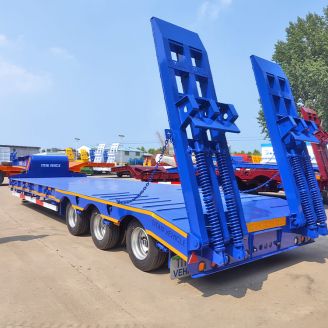
Loading ramps and deck flooring must resist extreme localized crushing forces when track-driven machinery climbs onto the platform. Constructing rear ramps from H60 high-strength steel thick-walled square tubing and laying a 5mm diamond pattern checker floor plate ensures structural longevity under severe mechanical impacts for transport fleets handling tough terrain in Nigeria, balancing frame strength with an affordable low bed trailer price.
● Heavy excavators exert severe point loads through their track grousers as they climb onto the rear deck. Ramps built from open channel steel flex and twist, eventually cracking at the pivot hinge.
● Heavy-duty trailers engineered for a service life exceeding 10 years utilize box-welded ramps constructed from thick-walled H60 square tubing and high-strength steel plate:
Dual heavy-duty helper spring packs or dual hydraulic cylinders reduce the manual effort required to raise and lower the ramps.
Ramps maintain a gentle incline angle (12 to 15 degrees) to allow safe loading of low-clearance asphalt pavers, rollers, and steel-tracked bulldozers.
The cargo platform uses a 5mm thick heavy-duty steel diamond checker plate. The raised pattern increases track traction, preventing heavy machinery from slipping during loading or transit. Heavy longitudinal support ribs positioned beneath the checker plate prevent permanent floor dishing between crossmembers.
Premium low bed trailer manufacturers undercarriage components require wide-stance suspension mountings and thick spring leaf packs to keep axles parallel and balance loads across off-road terrain. Specifying a 120mm wide suspension bracket with a 10mm wall thickness, a 70mm center balance pin, and 10-leaf spring packs (120mm wide by 16mm thick) prevents premature tire scrubbing and lateral instability in any heavy lowbed trailer for sale, which justifies a slightly higher low bed trailer price through long-term operational savings in Nigeria.
● The suspension equalizer rocker balances dynamic loads across adjacent axles as the trailer travels over obstacles. Lightweight highway trailers often use 50mm center pins housed within 6mm thick mounting brackets and 90mm wide spring leaves. Off-road, this lighter setup flexes laterally, causing wheel misalignment, severe tire scuffing, and early pin shear.
● Heavy duty low bed trailer manufacturers utilize a 70mm diameter center balance pin housed inside 120mm wide, 10mm thick reinforced mounting brackets. The larger pin surface area distributes bearing forces evenly, suppressing lateral sway and significantly extending leaf spring and tire life.
● Light-Duty Spring Pack: 90 mm width x 16 mm thickness x 10 leaves.
● Heavy-Duty Spring Pack: 120 mm width x 16 mm thickness x 10 leaves.
Increasing leaf spring width from 90 mm to 120 mm expands the spring cross-sectional area and bending resistance by over 33 percent. In daily operation, this upgrade provides an additional 15 metric tons of suspension load capacity, keeping the chassis stable on rough dirt roads.
Braking safety, wiring durability, and corrosion resistance are essential for a lowbed trailer operating in tropical, coastal, or dusty mining sites in Nigeria. Premium configurations pair 16-ton braking axles with dual-line WABCO relay valves, 10-year high-pressure synthetic rubber brake hoses, shielded electrical cables, and a baked powder paint finish—factors that heavily influence the final low bed trailer price for buyers inspecting a lowbed trailer for sale.
Axle Assemblies: Heavy-duty 16-ton capacity axles (such as FUWA or BPW) feature thick-walled axle tubes and large brake drums (420 x 220 mm friction linings) for efficient heat dissipation during long mountain descents.
Pneumatic Braking: Dual-line air braking system controlled by a WABCO RE-6 relay valve, featuring rapid response times and integrated ABS/EBS anti-lock safety controls.
Air Hose Durability: Air brake lines utilize high-pressure, UV-resistant synthetic rubber hoses fitted with solid brass connectors, achieving a service life rating exceeding 10 years under direct sunlight exposure.
Trailer wiring uses multi-core double-insulated copper cables housed inside oil-resistant conduit rated for over 5 years of continuous operation in severe environments. Sealed LED light clusters rated to IP67 protection standards prevent water and dust ingress.
Shot Blasting: The complete welded frame undergoes automated shot blasting to Sa 2.5 cleanliness standards, removing surface rust, mill scale, and welding oxides.
Primer Application: An epoxy zinc-rich primer coat (40 to 50 microns thick) is applied immediately to prevent flash rusting.
Powder Spraying & Curing: High-durability polyester powder paint is electrostatically applied and cured in a specialized oven at 180°C to 200°C. This forms a tough 120 to 150 micron protective shell that resists stone impacts, UV radiation, and industrial chemical exposure.
Analyzing a competitive low bed trailer price requires a thorough technical inspection of structural steel choices, weld standards, and undercarriage components where low-cost low bed trailer manufacturers trim production expenses. Common cost-cutting shortcuts—such as substituting Q460C steel with Q235 strip steel or fitting narrower leaf springs—reduce upfront manufacturing costs but diminish concentrated payload capacity by over 10 to 15 metric tons when evaluating a heavy-duty lowbed trailer for sale under operating conditions commonly found across Nigeria.
| Specification | TITAN Heavy Duty Engineering Spec | Market Low-Cost Competitor Spec | Engineering & Structural Impact |
| Main Beam | Q460C / HG60 High-Yield Cut Steel Plate | Q235 Slit Strip Steel (140mm Flange Width) | reduces dynamic impact resistance and lowers concentrated payload capacity by over 10 tons |
| Side Beam | 300mm Rolled H-Beam (Top: 8mm, Mid: 6mm, Bottom: 8mm) | Standard Rolled Steel Channel Section | Channel side beams curl inward under concentrated track loads, causing floor plate separation and main beam bending |
| Cross Members | HG60 bent 6mm manganese steel plate | 12# Standard Channel Steel Brackets | failing to unite frame forces; results in cargo deck sagging and side beam twisting |
| Suspension & Center Pin | 120mm Width, 10mm Thick Plate, 70mm Center Balance Pin | 90mm Width, 6mm Thick Plate, 50mm Center Pin | causing lateral flex, severe axle misalignment, and rapid tire scrub-wear |
| Leaf Spring | 120mm Width x 16mm Thickness x 10 Leaves | 90mm Width x 16mm Thickness x 10 Leaves | drop total undercarriage payload capacity by 15 metric tons and increase body sway |
| Service Life Rating | 10+ Years Continuous Off-Road Operation | 2 - 3 Years Before Structural Frame Repair | Initial low price is offset by higher total cost of ownership due to structural welding, premature tire wear, and fleet downtime |
The 3-axle 60-ton rigid lowbed trailer is a popular workhorse for transport fleets in Nigeria hauling medium-sized excavators, wheel loaders, and road rollers across highway and construction site routes. Designed to comply with standard highway axle weight limits, this model offers agility alongside a reliable 60-ton payload capacity and an optimal low bed trailer price.
Core Applications: 30 to 45 ton excavators, medium wheel loaders, asphalt pavers, compact bulldozers.
Deck Dimensions: Platform lengths typically range from 8,500 mm to 10,000 mm; platform width measures 3,000 mm (expandable to 3,500 mm using swing-out side outriggers).
Key Advantages: Offers a low tare weight combined with high frame rigidity, making it efficient for regional equipment relocation.
An 80-ton 3-axle or 4-axle lowbed trailer for sale provides enhanced deck stability and weight distribution when transporting heavy mining excavators and large track bulldozers. Built with double-plate reinforced goosenecks and Q460C main beams engineered by established low bed trailer manufacturers, this design withstands severe shock loads on unpaved logging and mining routes in Nigeria.
Core Applications: CAT D8 and D9 class bulldozers, 50 to 70 ton excavators, mobile crushing units, rotary drill rigs.
Deck Dimensions: Cargo deck lengths range from 10,000 mm to 12,000 mm, with working deck heights maintained between 900 mm and 1,050 mm under full load.
Key Advantages: Additional axle lines spread heavy gross weights over a larger surface area, helping operators comply with road axle limits while preventing sinkage on soft ground.
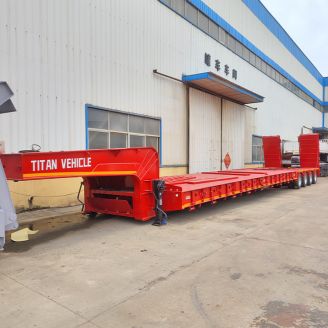
The 150 ton 4 line 8 axle lowbed trailer uses multi-axle lines with short tandem axles mounted side-by-side to distribute massive concentrated loads across a compact footprint. This multi-axle design satisfies strict per-axle ground pressure rules, making it indispensable for moving heavy industrial transformers and mining machinery for heavy infrastructure projects across Nigeria, where performance overrides the initial low bed trailer price.
Core Applications: 80 to 160 ton mining equipment, heavy transformers, large power station components, bridge girders.
Undercarriage Layout: Features 6 short axles mounted across 3 transverse axle lines. Dynamic load-equalizing beams balance ground forces across all 24 tires.
Key Advantages: Protects road surfaces from excessive wheel loads while enabling transport fleets to secure heavy haulage permits.
Front-Loading Removable Gooseneck (RGN) lowbed trailer for sale units feature a detachable front gooseneck that lowers the deck nose directly to the ground, creating a safe front-loading ramp for heavy tracked machinery. Certified low bed trailer manufacturers produce RGN models to eliminate the tipped-over risk associated with climbing steep rear ramps, providing excellent return on investment relative to the low bed trailer price.
Core Applications: Ultra-low clearance machinery, heavy directional drills, large cranes, industrial transformers, non-climbing equipment.
Operation: Hydraulic cylinders built into the gooseneck press against the truck frame to release the locking pins, detaching the gooseneck and placing the deck flat on the ground.
Key Advantages: Creates an easy 6 to 8 degree equipment loading slope, protecting specialized equipment from bottoming out.
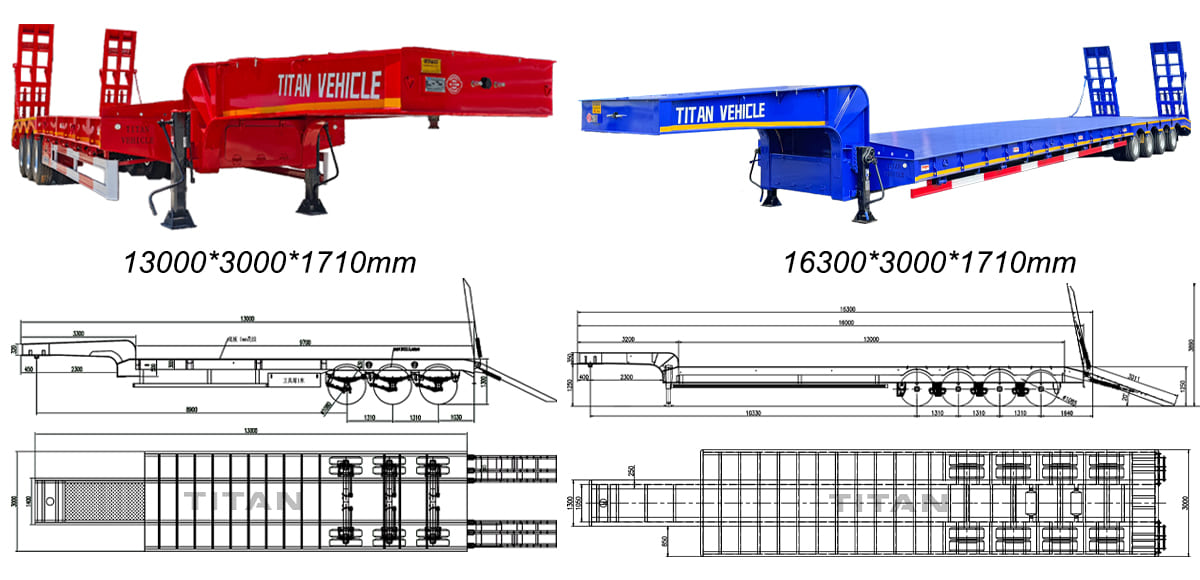 Low Bed Trailer Price | Heavy Duty Lowbed Trailer Manufacturers for Sale in Nigeria
1: What is a lowbed trailer for sale?
A low bed trailer, also known as a lowbed trailer or low loader, is a specialized semi-trailer featuring a cargo platform positioned significantly lower to the ground than standard trailers. It is specifically engineered to haul tall, heavy machinery and industrial equipment that exceed standard height and weight limits. Offered by reputable low bed trailer manufacturers, this low-profile deck maximizes vertical clearance under bridges and power lines while drastically improving transport stability.
2: How many tonnes can a lowbed trailer carry?
A 70mm center balance pin increases the surface bearing area and lateral stiffness of the suspension assembly, keeping trailer axles aligned on uneven terrain. Standard 50mm balance pins bend under heavy equipment payloads, causing axle misalignment that leads to rapid scrub-induced tire wear and premature suspension bushing destruction, which is why upgrading this component helps maintain a cost-effective low bed trailer price over its lifecycle.
3: What is the difference between a trailer and a lowbed trailer?
Standard flatbed trailers feature a uniform deck height sitting above the truck wheels, making them suitable for palletized freight, containers, and dry bulk goods. In contrast, a lowbed trailer incorporates a dropped cargo deck situated between the gooseneck and the rear axles to accommodate tall, concentrated machinery loads. This lowered center of gravity allows lowbeds to legally transport oversized equipment that would exceed height restrictions on a standard trailer.
4: What are the advantages of using a lowbed trailer?
The primary advantage of a lowbed trailer is its lowered deck height, which allows operators to legally transport tall machinery under overpasses and overhead cables. Additionally, lowering the payload's center of gravity significantly improves vehicle rollover resistance and lateral stability on unpaved roads. Heavy-duty lowbed trailer for sale options also provide exceptional structural rigidity to support concentrated track loads without frame sagging, giving fleet buyers the best low bed trailer price for operations on rough roads in Nigeria.
5: What are the different types of lowbeds?
The main categories include rigid (fixed) gooseneck lowbeds, removable gooseneck (RGN) lowbeds, extendable lowbeds, and hydraulic modular low loaders. Rigid goosenecks rely on heavy rear ramps for equipment loading, whereas RGN models detach at the front so crawler machines can drive straight onto the deck at a low incline angle when looking at a lowbed trailer for sale. Extendable and modular types are designed for unusually long or ultra-heavy loads such as wind turbine blades and industrial transformers.
6: How do low loader trailers work?
Low loader trailers work by positioning the main cargo deck lower than the top of the axle assemblies, transferring the payload weight evenly across a tractor's fifth wheel and the trailer's rear suspension. Equipment is loaded onto the deck either by climbing heavy-duty rear ramps or by driving directly onto the platform after disconnecting a front removable gooseneck. Once secured, the multi-axle mechanical or hydraulic suspension built as recommended by low bed trailer manufacturers distributes dynamic ground forces evenly across all tires during transit for haulage trailers in Nigeria.
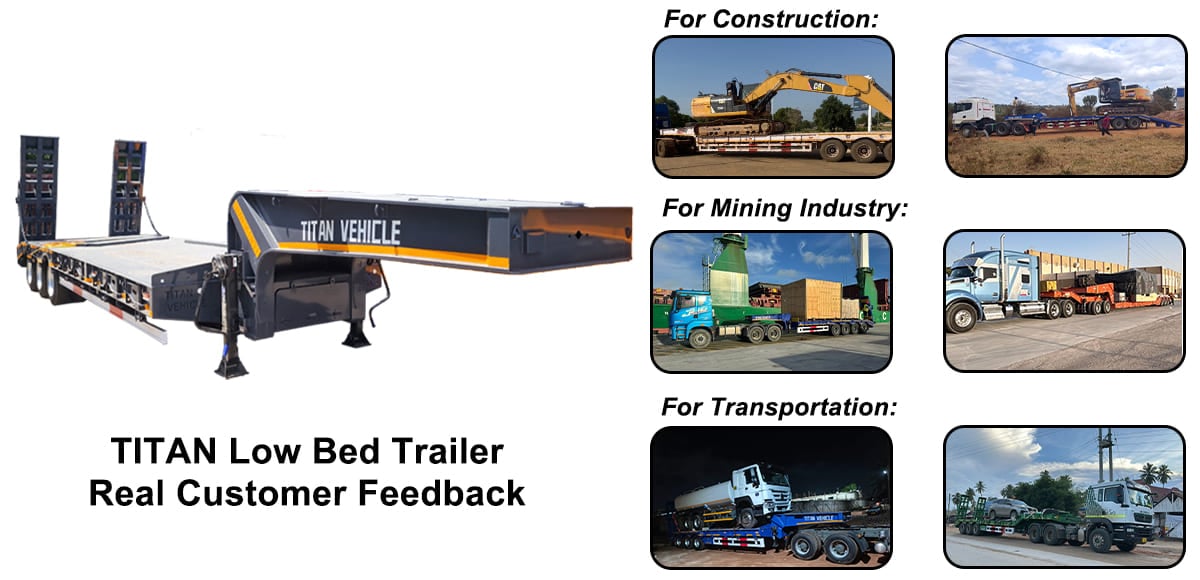 Low Bed Trailer Price | Heavy Duty Lowbed Trailer Manufacturers for Sale in Nigeria
Shandong TITAN Vehicle Co., Ltd.
Wehcat/Whatsapp: +86 18660159635
Tel.: +86531-88997626

BOSS WeChat

Boss Whatsapp