
Since 2014
Ten Years of Reliability Your Trusted Partner
Ten Years of Reliability Your Trusted Partner
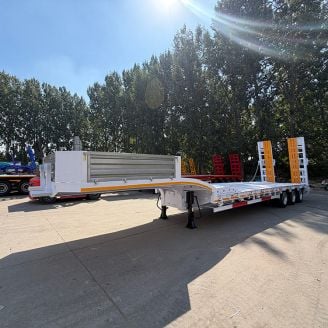
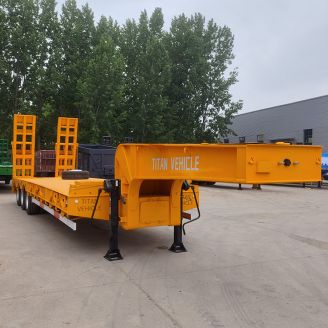
Lowbed trailers and flatbed trailers are both popular heavy-duty semi trailers for cargo hauling, but they are designed for totally different transport tasks.
1.1 Core Differences
Flatbed semi trailer and lowbed semi trailer are two mainstream heavy-duty transport equipment for freight hauling, but they adopt completely different structural designs.
A standard flat deck trailer, also known as flat bed trailers for sale, comes with a full flat platform and standard deck height. Equipped with professional container twist locks, this heavy duty flatbed trailer focuses on versatility and flexible loading for daily mixed logistics.
In comparison, the lowbed trailer for sale, also called low loader trailer or semi lowbed trailer, features a dropped low deck and ultra-low overall height. The low bed semi trailer is structurally reinforced to bear super-heavy loads, solving height limit problems that ordinary flatbed trailers cannot handle.
1.2 Suitable Cargo
Flatbed trailer for sale is ideal for standardized and general freight, including 20ft/40ft shipping containers, steel coils, steel pipes, construction materials, timber and bulk cargo. It perfectly fits port transit, inland container haulage and general logistics delivery.
By contrast, lowbed semi trailer is exclusively designed for oversized, over-height and overweight cargo. It is widely used to transport excavators, bulldozers, loaders, cranes and large engineering machinery, which cannot be loaded on ordinary flat deck trailers.
1.3 Simple Selection Rule
Choose a heavy duty flatbed trailer if your core business covers container transportation and daily mixed bulk freight; choose a low loader trailer and lowbed trailer for sale if you mainly transport tall, oversized and heavy construction equipment with strict height and weight limits.
A lowbed trailer, also widely known as a low loader trailer, semi lowbed trailer or low bed semi trailer, is a professional heavy-duty semi-trailer specially designed for oversized and overweight cargo transportation. It is one of the most popular heavy haulage trailers available when searching for a lowbed trailer for sale, widely used in engineering, mining and heavy equipment logistics worldwide.
2.1 Lowbed Trailer Definition
A lowbed semi trailer is a specialized heavy transport vehicle with a drop-center low-platform frame structure. It abandons the standard flat deck height of a conventional heavy duty flatbed trailer. With reinforced thickened main beams and an ultra-low gravity center design, it is purpose-built for heavy, tall and out-of-gauge cargo transport, becoming the core equipment for professional heavy haul logistics.
2.2 Low Deck Structural Features
• Dropped Drop-Center Deck Design
The most recognizable feature of a low loader trailer is its drop-center low deck. The middle loading platform sinks down between the front gooseneck and rear wheel bogie. This separated layout creates a much lower cargo surface compared with flatbed trailer for sale.
• Reinforced High-Strength Main Frame
The whole frame adopts thickened high-tensile steel. Main beams and cross members are fully reinforced to resist torsion and bending. This heavy-duty construction prevents frame deformation under extreme heavy loads, far stronger than standard flat deck trailer.
• Reasons for Ultra-Low Platform Height
The low platform design is the core advantage of low bed semi trailer. By optimizing the frame structure and reducing the middle beam height, the trailer greatly lowers the overall cargo loading height. This effectively avoids road height limit violations, allowing over-height mechanical equipment to pass highways and municipal roads legally and safely, which cannot be achieved by standard flatbed semi trailer.
• Functions of Hydraulic and Mechanical Ramps
Mechanical ramps are the cost-effective option for lowbed trailer for sale, widely fitted on standard low loader trailer models. Built with heavy-duty steel structure, they rely on manual or spring-assisted lifting. They allow self-propelled construction machinery to drive onto the lowbed semi trailer without a crane. Simple structure means low maintenance cost and easy repair at remote construction or mining sites, ideal for users with limited budget.
Hydraulic ramps are premium optional accessories for semi lowbed trailer and low bed semi trailer. Controlled by hydraulic power, the ramps can lift, lower and adjust the gradient smoothly with one-button operation. They support heavier equipment loads and require less manual labor. Hydraulic ramps deliver faster loading & unloading speed and higher safety, preferred for frequent heavy haul projects compared to mechanical ramps.
2.3 Common Axle Configurations and Load Range
• Available Axle Options
Lowbed trailer for sale provides multiple axle selections to match different hauling requirements, including 2-axle, 3-axle, 4-axle and multi-line multi-axle designs. More axles distribute weight evenly across road surfaces, reducing ground pressure and meeting strict local road regulations. Buyers searching for low loader trailer or semi lowbed trailer can choose axle quantity according to their regular cargo weight and local permit rules.
• Rated Load Capacity
Standard low bed semi trailer normally covers a load range from 60 tons to 120 tons. Custom heavy-duty versions can support higher tonnage for ultra-heavy mining and industrial equipment. Compared with flat bed trailers for sale and heavy duty flatbed trailer, lowbed semi trailer delivers superior load-bearing performance and better structural stability during continuous heavy-load transportation.
2.4 Typical Application Scenarios
Lowbed semi trailers are widely used for transporting over-height, over-width and overweight cargo. Typical transport objects include excavators, bulldozers, loaders, cranes, mining machinery and large industrial equipment. It is commonly applied in engineering project delivery, mining logistics, infrastructure construction and cross-region heavy equipment transfer, perfectly compensating for the functional limitations of heavy duty flatbed trailer in oversized cargo transportation.
A flatbed trailer, also known as flatbed semi trailer, flat deck trailer or heavy duty flatbed trailer, is the most versatile and widely used general-purpose semi-trailer in modern intermodal logistics. Most buyers searching for flat bed trailers for sale choose this model for its flexible loading, strong compatibility and cost-effective daily transportation. Unlike lowbed semi trailer and low loader trailer designed for oversized machinery, the flatbed trailer focuses on container haulage and mixed general freight.
3.1 Flatbed Trailer Definition
A flatbed semi trailer is an open-platform heavy-duty transport trailer with a full flat deck and standard deck height. It features no side walls or roof, maximizing loading space and flexibility. Equipped with standard container twist locks, this heavy duty flatbed trailer is designed for standardized container transportation and various bulk cargo delivery, serving as the mainstream logistics trailer for port, urban and inland freight transit.
3.2 Flat Deck Structural Features
• Full Open Flat Platform Design
Different from the drop-center structure of lowbed trailer for sale, the flat deck trailer adopts a fully flat and integrated deck surface. The entire platform is smooth and level, supporting full-plane stress bearing. It allows loading from top, side and rear directions, greatly improving cargo adaptability compared with semi lowbed trailer.
• Reinforced Welded Frame Structure
The flatbed trailer frame is welded with high-strength steel main beams and dense cross beams. The overall structure is solid, uniform in stress distribution and resistant to torsion. Thickened deck plates effectively prevent deformation during long-term bulk cargo transportation, ensuring stable and durable daily operation.
• Standard Container Twist Lock Configuration
All standard flat bed trailers for sale are pre-installed with ISO standard twist locks. The lock positions are precisely arranged to match 20ft and 40ft shipping containers, realizing fast positioning and firm locking. This core configuration makes flatbed semi trailer the best choice for container intermodal transportation.
3.3 Common Axle Configurations and Load Range
• Available Axle Options
Flatbed trailer for sale supports flexible axle combinations to adapt to different logistics needs, including 2-axle, 3-axle and 4-axle configurations. The 3-axle heavy duty flatbed trailer is the most mainstream model, balancing load capacity, fuel economy and road adaptability for daily mixed freight.
• Rated Load Capacity
The standard load range of flatbed semi trailer is 30 tons to 60 tons. With lightweight optimized design and high-strength steel frame, it achieves larger legal payload under road weight limits. Although its heavy-load performance is lower than low loader trailer, it has higher cost performance for conventional container and bulk cargo transportation.
3.4 Typical Application Scenarios
Flatbed semi trailer is widely used in standardized and comprehensive logistics scenarios. Its main businesses include port container transit, inland container haulage, steel structure and steel pipe transportation, timber and bulk cargo delivery, and general engineering material transportation. As the most versatile heavy duty flatbed trailer, it is the preferred equipment for most logistics fleets with mixed and daily freight orders.
Many buyers searching for flatbed trailer for sale, flatbed semi trailer, heavy duty flatbed trailer, as well as lowbed trailer for sale, low loader trailer and low bed semi trailer often confuse these two trailer types. Although both are mainstream heavy-duty semi trailers for road freight transportation, flat deck trailer and semi lowbed trailer adopt completely different design positioning. Flatbed trailers focus on versatile general logistics, while lowbed trailers are specialized for oversized heavy haulage. Understanding their core differences helps fleet owners select the most suitable trailer and avoid unnecessary transportation risks and costs.
4.1 Structural & Deck Height Differences
• Flatbed Trailer Structure
A standard flatbed semi trailer features a full flat, level open deck with conventional standard height. The entire platform is integrated without sunk or raised sections. The frame structure is simple, stable and highly symmetrical. All flat bed trailers for sale are reserved with standard container twist lock positions, specially optimized for container fixation and general bulk cargo placement. The standard deck height ensures normal vehicle overall height, suitable for daily road running and regular logistics transportation.
• Lowbed Trailer Structure
Different from flat deck trailer, the lowbed semi trailer (also known as low loader trailer or semi lowbed trailer) adopts a typical drop-center low platform structure. The middle loading deck is significantly sunk between the front gooseneck and rear wheel bogie. This special low-frame design greatly reduces the effective loading height. The whole beam is thickened and reinforced to adapt to heavy torsion and pressure, making the structural design completely different from ordinary heavy duty flatbed trailer.
4.2 Rated Load & Bearing Capacity Differences
• Flatbed Trailer Load Range
Heavy duty flatbed trailer is designed for medium and conventional heavy cargo. Its standard load capacity ranges from 50 tons to 80 tons. The frame is optimized for balanced bearing, suitable for long-distance and high-frequency daily logistics. It meets the weight limit requirements of most national highways and does not exceed regular road load standards, achieving the best balance between payload and fuel economy.
• Lowbed Trailer Load Range
Lowbed trailer for sale is positioned for super heavy haulage. With reinforced main beam, thickened floor and multi-axle load dispersion design, its conventional load range reaches 60 tons to 120 tons. Custom multi-line low bed semi trailer can achieve higher super-heavy bearing capacity. It can stably bear centralized overweight cargo that flatbed semi trailer cannot support, effectively avoiding frame deformation and tire overload damage.
4.3 Applicable Cargo Type Differences
• Flatbed Trailer Suitable Cargo
Flat deck trailer is the best choice for standardized and regular freight. It is widely used for transporting 20ft and 40ft shipping containers, steel coils, steel beams, steel pipes, construction materials, timber and other bulk cargo. For port container turnover, inland container transportation and general engineering material delivery, flat bed trailers for sale show extremely high compatibility and transportation efficiency.
• Lowbed Trailer Suitable Cargo
Low loader trailer and semi lowbed trailer are exclusively used for over-height, over-width and overweight oversized cargo. It mainly transports various self-driving construction and mining machinery, including excavators, bulldozers, wheel loaders, road rollers, cranes and large industrial equipment. These tall and heavy mechanical cargos cannot be legally and safely transported by ordinary heavy duty flatbed trailer.
4.4 Lowbed vs Flatbed Trailer Comparison Table
|
Item
|
Flatbed Trailer
|
Lowbed Trailer
|
|
Deck Structure
|
Full flat open deck, standard height
|
Drop-center low deck, ultra-low platform
|
|
Loading Height
|
Standard height, fully road compliant
|
Ultra-low height, solves over-height limit problem
|
|
Main Cargo
|
Containers, steel, pipes, bulk cargo
|
Excavators, bulldozers, heavy machinery
|
|
Rated Load
|
50 – 80 tons
|
50 – 120 tons
|
|
Loading Method
|
Crane & forklift loading
|
Hydraulic/mechanical ramp, drive-on loading
|
|
Road Permit
|
No special permit required
|
Oversize permit usually required
|
|
Core Advantage
|
Versatile, flexible, high cost performance
|
Super load capacity, over-height cargo passable
|
• Quick Verdict
- Pick flatbed trailer for sale (flatbed semi trailer / flat deck trailer) if your main cargo is containers, steel or bulk goods.
- Pick lowbed trailer for sale (low loader trailer / semi lowbed trailer / low bed semi trailer) if you move tall, oversized heavy machinery.
When browsing flatbed trailer for sale, flatbed semi trailer, heavy duty flatbed trailer or lowbed trailer for sale, many fleet managers and logistics contractors struggle to pick the proper trailer setup. Low loader trailer, semi lowbed trailer and low bed semi trailer each serve unique transport demands. Selecting the right trailer configuration relies on your cargo specifications, regular transport routes, local transport regulations and long-term fleet operation plan. A wrong choice may trigger safety hazards, extra permit fees or low asset utilization.
5.1 Evaluate Your Main Cargo Type & Dimensions
• Flatbed Trailer Selection Condition
Pick flat deck trailer if your primary cargo is 20ft / 40ft shipping containers, steel beams, steel pipes, timber and general bulk goods. Measure cargo weight and check whether the goods have regular height. A heavy duty flatbed trailer works best for standard cargo without oversize limits.
• Lowbed Trailer Selection Condition
Go for lowbed semi trailer or low loader trailer when you mainly haul over-height, over-width and overweight equipment, such as excavators, bulldozers, wheel loaders and mining machines. Confirm the overall height, weight and width of machinery. Semi lowbed trailer and low bed semi trailer are built for oversized heavy loads that cannot be carried by flat bed trailers for sale.
5.2 Confirm Payload Requirement and Axle Setup
• Axle and Load for Flatbed Trailer
Flatbed trailer for sale commonly adopts 2-axle, 3-axle or 4-axle design. The 3-axle flatbed semi trailer is the most popular model with rated load from 30 tons to 60 tons. Match axle quantity according to your regular cargo weight and local highway weight restrictions to avoid axle overload and fines.
• Axle and Load for Lowbed Trailer
Lowbed trailer for sale offers flexible axle combinations ranging from 2-axle, 3-axle, 4-axle to multi-line multi-axle versions. Its load capacity ranges from 60 tons up to 120 tons or higher for custom models. More axles spread heavy weight evenly on road surfaces, meeting strict weight rules for heavy haul.
5.3 Check Road Condition and Local Transport Rules
• Road Height & Weight Limits
For flat deck trailer transport, most standard container and bulk cargo stays within normal height and weight limits, so special oversize permits are usually unnecessary. For lowbed semi trailer, tall heavy machinery often exceeds road dimension limits. You will need to apply for oversize transport permits and arrange escort services in many regions.
• Site Loading Conditions
Check your loading yards or project sites. If cranes and forklifts are available for loading, flat bed trailers for sale are a practical option. If you often work on remote construction or mining sites without hoisting machines, low loader trailer equipped with hydraulic or mechanical ramps allows machinery to drive on directly.
• 5.4 Additional Custom Options
For flatbed trailer: you can upgrade twist locks, side stakes, reinforced floor plate or air suspension based on cargo features.
For lowbed trailer: choose mechanical ramps for budget projects or hydraulic ramps for frequent loading work; removable gooseneck is an optional upgrade for easier loading of ultra-large equipment.
5.6 Quick Selection Checklist
• Identify your most frequent cargo type, weight, width and height
• Review local highway weight, height and oversize permit requirements
• Inspect loading site facilities (crane, forklift or no hoisting equipment)
• Calculate purchase cost, maintenance expense and expected utilization
• Select axle quantity and optional accessories to match your transport tasks
If you are searching for flatbed trailer for sale, flatbed semi trailer, heavy duty flatbed trailer or lowbed trailer for sale, these FAQs answer the most common questions raised by fleet buyers about low loader trailer, semi lowbed trailer and low bed semi trailer
Q1: Can a lowbed trailer carry containers?
Technically, a lowbed semi trailer can physically hold a shipping container, but it is not purpose-built for container transport. Lowbed trailer for sale lacks standard fixed ISO twist locks for containers. Its drop-center low deck design is optimized for over-height heavy machinery rather than intermodal container hauling.
Q2: Can a flatbed carry a 40ft container?
Yes. A standard flatbed semi trailer, also known as flat deck trailer, is fully equipped with ISO standard twist locks. Heavy duty flatbed trailer can safely load and transport 40ft shipping containers, as well as 20ft containers. Flat bed trailers for sale are widely used for port and inland container transportation, which is one of their core application scenarios. You only need to confirm the trailer’s rated load and deck length before hauling the 40ft container.
Q3: Which trailer is suitable for heavy machinery?
A lowbed trailer for sale, including low loader trailer, semi lowbed trailer and low bed semi trailer, is the ideal choice for heavy machinery transport. Its dropped low deck reduces overall cargo height, and the reinforced heavy-duty frame supports overweight loads such as excavators, bulldozers, wheel loaders and mining equipment. Equipped with hydraulic or mechanical ramps, it allows self-propelled machinery to drive directly on board, a function that ordinary flatbed trailer for sale cannot achieve.
Q4: Can lowbed and flatbed trailers be customized?
Absolutely. Both flatbed semi trailer and lowbed semi trailer support customized production. For heavy duty flatbed trailer, available custom options include air suspension, reinforced deck plates, upgraded twist locks and side stakes. For low loader trailer and semi lowbed trailer, buyers can choose mechanical or hydraulic ramps, removable gooseneck, different axle quantities and high-strength steel materials. You can tailor the trailer configuration according to your cargo size, weight and local road requirements.
Q5: What information is needed to order a semi-trailer?
When ordering flat bed trailers for sale or lowbed trailer for sale, you need to provide key parameters: main cargo type, maximum cargo weight, cargo width and height, required axle quantity, target load capacity, local road weight and height regulations, preferred suspension type and optional accessories such as twist locks or ramps. Providing these details helps the manufacturer design a suitable flatbed semi trailer or low bed semi trailer for your hauling business.
Shandong TITAN Vehicle Co., Ltd.
Wehcat/Whatsapp: +86 18660159635
Tel.: +86531-88997626

BOSS WeChat

Boss Whatsapp